

Every so often, the global economy experiences what economists call a commodity supercycle.
It’s a 10-to-25-year period where prices remain dramatically elevated because structural demand overwhelms the supply system’s ability to respond.
And by understanding these cycles, we’ll be able to pinpoint where the next one lies.
Perhaps an obvious example can be found in the Second Industrial Revolution.
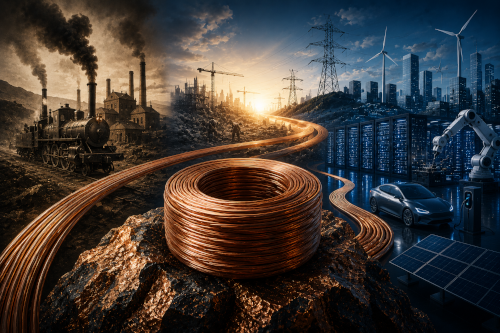
That was the starting point in the mid-19th century when the steam engine replaced human muscle, and copper became a vital ingredient for infrastructure.
It makes sense, doesn’t it? After all, railways need copper wiring, as well as all the factories that started popping up that required copper for their various electrical systems and machinery.
By 1860, Britain’s coal output exploded from 100,000 tons in 1800 to 17 million tons, and copper soon followed the same trajectory.
The industrial heartbeat was coal, steel, and copper… and we just couldn’t get enough of them.
However, supply eventually caught up as new mines opened globally, but not before two generations of elevated prices reshaped global economics and created enormous wealth for early producers and mining nations.
Let’s go a generation or two down the road, and we’ll find ourselves in the midst of a post-WWII reconstruction supercycle.
Europe and Japan lay in ruins.
To rebuild, the Marshall Plan was implemented, which allocated over $13 billion for western Europe’s recovery. For the record, that’s roughly $140 billion in today’s money.
Japan needed to modernize, and Australia, Canada (along with other Allied nations) needed to transition from wartime to peacetime production.
Of course, that reconstruction also required copper for everything, from electrical grids, telecommunications infrastructure and manufacturing equipment, to ships, aircrafts and more.
As you might’ve guessed, copper demand soared through the 1950s and 1960s as the entire Western world rebuilt simultaneously.
It took until the 1970s for supply to catch up.
The Best Free Investment You’ll Ever Make
Our analysts have traveled the world over, dedicated to finding the best and most profitable investments in the global energy markets. All you have to do to join our Energy and Capital investment community is sign up for the daily newsletter below.
Copper’s Supercycle is Different
Previous commodity supercycles like we just talked about followed an almost identical pattern.
They saw structural demand emerge suddenly and overwhelm existing supply. So, it logically follows that prices rose dramatically as miners worldwide kickstarted new projects.
Eventually, supply caught up after 7-10 years, prices peaked and then fell, the cycle ended.
The cycle was simple and predictable.
Is today’s cycle inverting this pattern?
I’ll let you decide…
Rather than demand suddenly erupting and blindsiding a prepared supply system, the supply system has been chronically starved of investment for nearly 15 years.
From 2011 to 2025, mining companies practiced extreme capital discipline. That means budgets were slashed, new projects shelved, and existing mines operated in maintenance mode rather than expansion.
In other words, the supply infrastructure atrophied.
Meanwhile, demand started arriving from multiple directions simultaneously — not from one country’s infrastructure boom like China, mind you, but from new catalysts like energy transition, defense manufacturing, electrification infrastructure buildout, and industrial reshoring.
And the result is something historically unusual — copper now faces a structural supply deficit that was in place before demand peaked.
Folks, that’s the opposite of every previous supercycle.
In 1998, the supply system was prepared. In 1945, even with Europe destroyed, mining capacity existed. And all the way back in 1850, the constraints were geological discovery, not capital investment.
Today, capital discipline created the shortage before the demand wave fully arrived.
You see, supply-driven supercycles historically produce more sustained price appreciation and longer bull markets than demand-driven ones.
Why, you ask? Well, because supply simply can’t respond fast enough.
A new copper mine takes 10-15 years from discovery to first production.
Even with perfect capital allocation and no permitting delays, you’re looking at a decade minimum.
And right now we’re in the first year of this supercycle.
The supply deficit that exists today will persist through the early 2030s at minimum.
By the time new mines come online in significant volume (think as far as 2032, 2033, and 2034), the demand environment will have matured into its mid-cycle phase. That’s when prices typically reach their most elevated levels in a supercycle, because the market realizes supply actually can’t catch demand, and the shortage becomes permanent, not temporary.
Look, every supercycle has distinct phases.
In the accumulation phase (which is where we are now), prices rise, but they certainly aren’t parabolic… not yet, at least. The response from supply is also minimal as investor sentiment remains constructive, but not euphoric.
Sure, capital spending rises, but definitely not at boom-time levels.
This is the phase where patient capital gets built — when early buyers lock in before the consensus catches on to the structural shortage.
It’s also the phase that historically produces the longest and most sustained returns, because early positioning captures the entire “supply response fails to materialize” window.
Again, today is a little different because we’re seeing constrained supply before demand has peaked. That means the timing dynamic is essentially inverted, and the shortage gets worse before it gets better.
Every quarter that passes without significant new mine capacity coming online further tightens the situation, and prices have room to move higher as the market comes to grips with the reality that supply simply can’t keep up.
Copper isn’t at a peak, and we’re not even at the midpoint of the cycle.
That window doesn’t stay open forever — we’ll dive into those opportunities next time.
Until next time,

Keith Kohl
 Check us out on YouTube!
A true insider in the technology and energy markets, Keith’s research has helped everyday investors capitalize from the rapid adoption of new technology trends and energy transitions. Keith connects with hundreds of thousands of readers as the Managing Editor of Energy & Capital, as well as the investment director of Angel Publishing’s Energy Investor and Technology and Opportunity.
For nearly two decades, Keith has been providing in-depth coverage of the hottest investment trends before they go mainstream — from the shale oil and gas boom in the United States to the red-hot EV revolution currently underway. Keith and his readers have banked hundreds of winning trades on the 5G rollout and on key advancements in robotics and AI technology.
Keith’s keen trading acumen and investment research also extend all the way into the complex biotech sector, where he and his readers take advantage of the newest and most groundbreaking medical therapies being developed by nearly 1,000 biotech companies. His network includes hundreds of experts, from M.D.s and Ph.D.s to lab scientists grinding out the latest medical technology and treatments. You can join his vast investment community and target the most profitable biotech stocks in Keith’s Topline Trader advisory newsletter.


